Titan
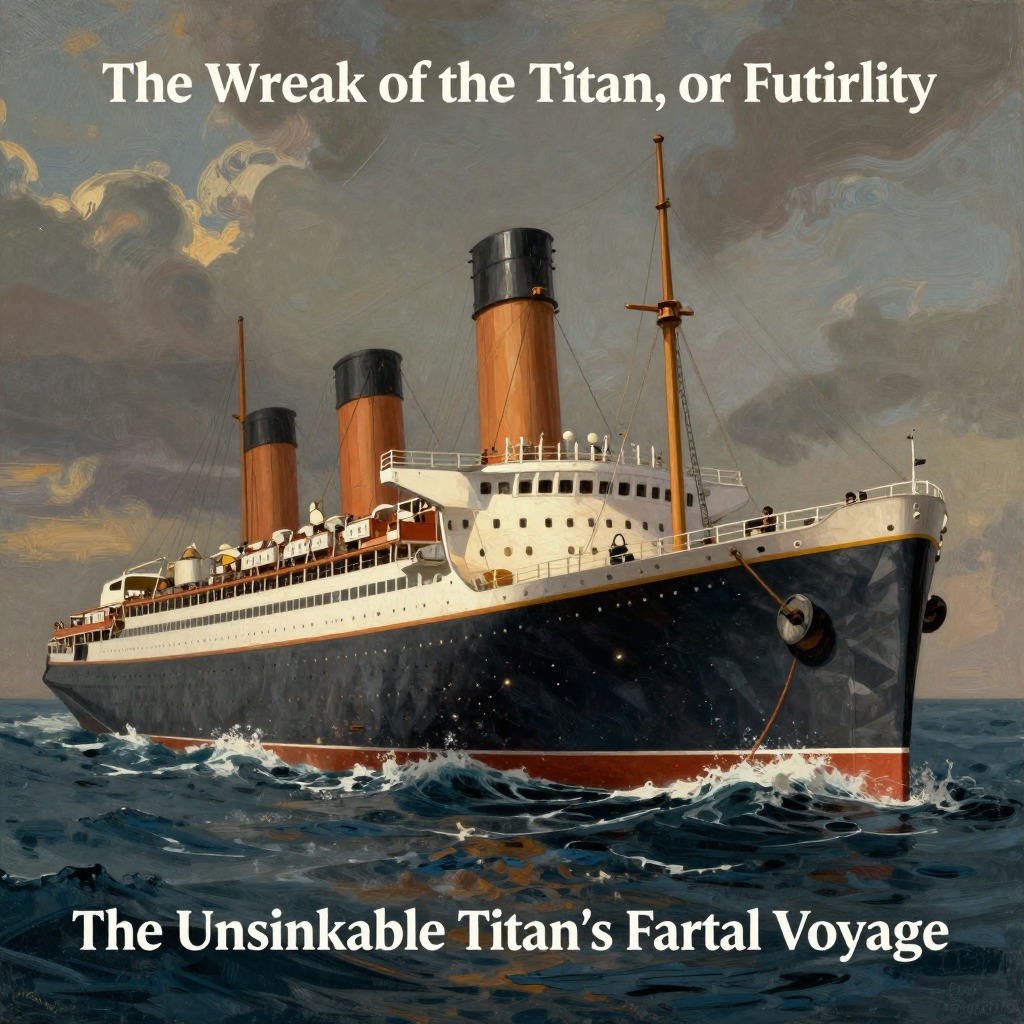
The Titan is the colossal, supposedly unsinkable steamship at the center of Morgan Robertson's 1898 novella The Wreck of the Titan, or Futility. As the largest craft afloat and the greatest of the works of men, it embodies the technological hubris of the era, yet its design flaws, reckless operational rules, and the crew's criminal negligence lead to its catastrophic collision with an iceberg and the loss of nearly all aboard. The ship's fate drives the novel's critique of industrial greed, human fallibility, and the illusion of invincibility.
Design and Construction
The Titan was built of steel throughout, eight hundred feet long, with a displacement of seventy thousand tons and seventy-five thousand horsepower. On her trial trip she had steamed at twenty-five knots an hour over the bottom, in the face of unconsidered winds, tides, and currents. Her designers, freed from the demands of cargo space, gave her the sharp dead-rise of a steam yacht, which improved her behavior in a seaway. She carried no combustible cargo, reducing the threat of fire. In short, she was a floating city, containing within her steel walls all that tends to minimize the dangers and discomforts of the Atlantic voyage.
Her safety features were extensive. From the bridge, engine-room, and a dozen places on her deck, the ninety-two doors of nineteen water-tight compartments could be closed in half a minute by turning a lever. These doors would also close automatically in the presence of water. With nine compartments flooded the ship would still float, and so no known accident of the sea could possibly fill this many; the steamship Titan was considered practically unsinkable. Yet this confidence was undermined by her lifeboat provision: she carried only twenty-four boats, securely covered and lashed down to their chocks on the upper deck, which if launched would hold five hundred people. She carried no life-rafts, but each of the three thousand berths contained a cork jacket, and about twenty circular life-buoys were strewn along the rails.
Operational Rules and the Full-Speed Policy
The Titan's company announced a rule of navigation that was thoroughly believed in by some captains but not yet openly followed: she would steam at full speed in fog, storm, and sunshine, and on the Northern Lane Route, winter and summer. The reasons were substantial in the company's view. First, if another craft should strike her, the force of the impact would be distributed over a larger area if the Titan had full headway, and the brunt of the damage would be borne by the other. Second, if the Titan was the aggressor she would certainly destroy the other craft, even at half-speed, and perhaps damage her own bows; while at full speed, she would cut her in two with no more damage to herself than a paintbrush could remedy. A third reason was that, at full speed, she could be more easily steered out of danger, and a fourth, that in case of an end-on collision with an iceberg—the only thing afloat that she could not conquer—her bows would be crushed in but a few feet further at full than at half speed, and at the most three compartments would be flooded, which would not matter with six more to spare.
This policy was put into practice on the voyage that ended in disaster. The Titan had beaten all records on her maiden voyage, but up to the third return trip had not lowered the time between Sandy Hook and Daunt's Rock to the five-day limit; it was unofficially rumored among the two thousand passengers who had embarked at New York that an effort would now be made to do so. The ship charged through a fog-bank at undiminished speed, with two deck officers and three lookouts straining sight and hearing to the utmost.
The Collision with the Royal Age
On the first night out from New York, the Titan's full-speed policy led to a horrific collision. At about a quarter past twelve, the lookout in the crow's-nest reported a ship ahead. The first officer ordered the wheel hard aport, but before three degrees on the compass card were traversed, a deep-laden ship crossing the Titan's bow appeared, not half her length away. The first officer turned a lever which closed compartments, pushed a button marked "Captain's Room," and crouched down, awaiting the crash. There was hardly a crash; a slight jar shook the forward end of the Titan, and sliding down her foretopmast-stay came a shower of small spars, sails, blocks, and wire rope. In the darkness, two darker shapes shot by—the two halves of the ship she had cut through. From one of these shapes, where still burned a binnacle light, was heard a sailorly voice: "May the curse of God light on you and your cheese-knife, you brass-bound murderers." The ship was the Royal Age, and the Titan's officers, under orders to maintain silence, attempted to bribe the lookout John Rowland with one hundred pounds to keep quiet about the incident.
The Iceberg Collision and Sinking
The Titan's end came on the second night, when she struck an iceberg. Seventy-five thousand tons dead-weight, rushing through the fog at the rate of fifty feet a second, hurled itself at the ice. A low beach, possibly formed by the recent overturning of the berg, received the Titan, and with her keel cutting the ice like the steel runner of an iceboat, and her great weight resting on the starboard bilge, she rose out of the sea, higher and higher—until the propellers in the stern were half exposed—then, meeting an easy, spiral rise in the ice under her port bow, she heeled, overbalanced, and crashed down on her side, to starboard. The holding-down bolts of twelve boilers and three triple-expansion engines snapped, and down through a maze of ladders, gratings, and fore-and-aft bulkheads came these giant masses of steel and iron, puncturing the sides of the ship, even where backed by solid, resisting ice, and filling the engine and boiler-rooms with scalding steam, which brought a quick, though tortured death, to each of the hundred men on duty in the engineer's department.
Amid the roar of escaping steam, the bee-like buzzing of nearly three thousand human voices, and the whistling of air through hundreds of open dead-lights, the Titan moved slowly backward and launched herself into the sea, where she floated low on her side—a dying monster, groaning with her death-wound. The ship sank with nearly all of her people, unable to climb vertical floors and ceilings. The only survivors were those in Lifeboat No. 24, which had been cleared away, carrying the first officer, seven sailors, and one lady passenger, Mrs. Selfridge, along with a few others.
Aftermath and Legacy
The loss of the Titan became a cause célèbre. At Lloyds in London, the underwriters were thrown into an uproarious panic when the Crier announced that the great Titan was destroyed. The papers of Europe and America issued extras giving the meager details of the arrival at New York of one boat-load of her people. The ship's captain, Captain Bryce, and first officer, Mr. Austen, concealed the collision with the Royal Age in their sworn statements, but John Rowland's testimony, delivered at Mr. Meyer's office, exposed the truth. The insurance on the Titan was ultimately paid, despite Mr. Meyer's attempts to void the policy, because Rowland refused to testify that the ship's lights were out, and because the cause of the wreck was full speed in a fog, a risk the underwriters had knowingly taken.
The Titan's story is a cautionary tale about technological arrogance. Despite her water-tight compartments and her reputation as unsinkable, she was destroyed by a combination of human error, corporate greed, and the unforgiving forces of nature. The ship's fate foreshadows the real Titanic disaster of 1912, making Robertson's novella a chillingly prophetic work.